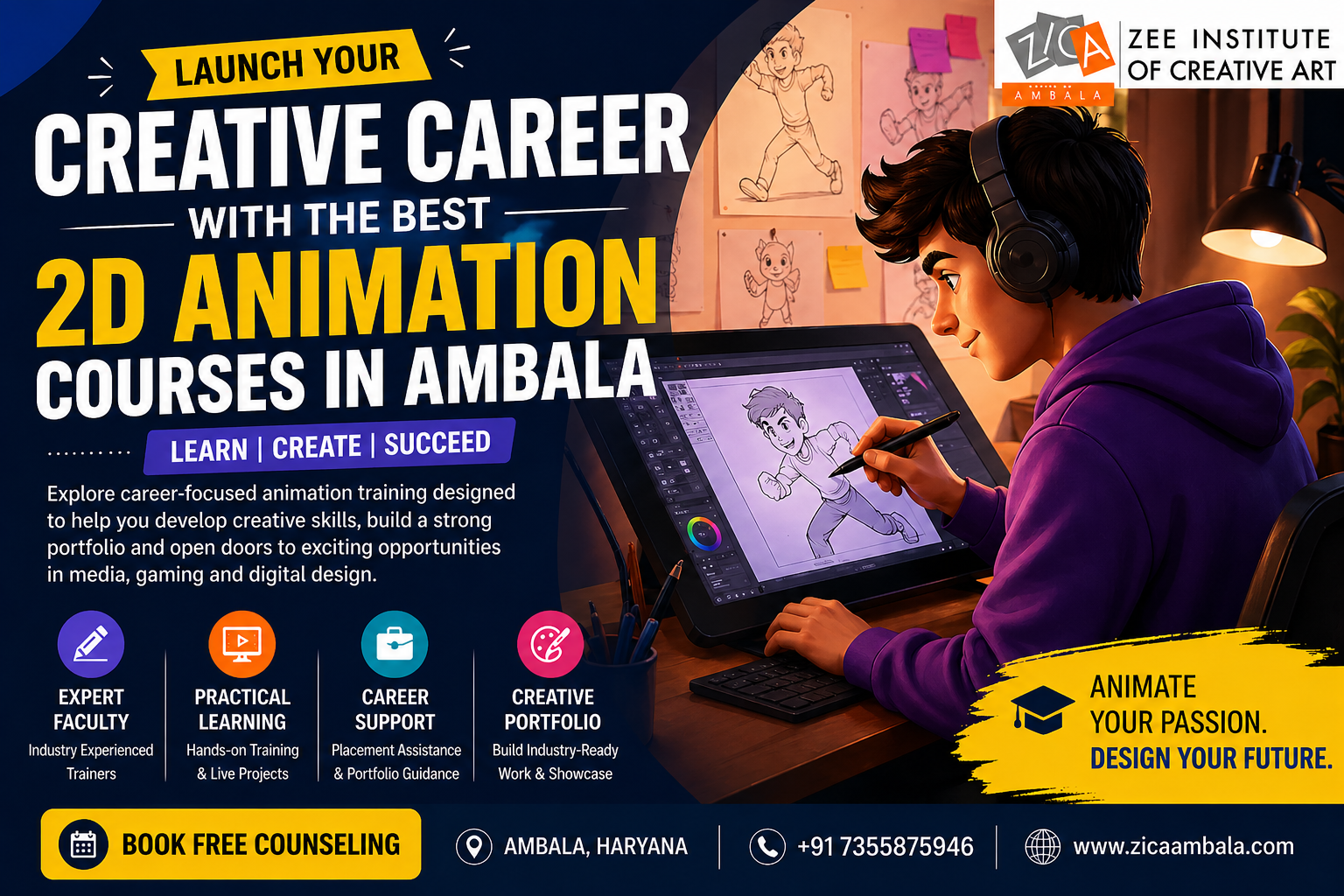
Best 2D Animation Courses in Ambala for Creative Careers
Social Sciences
S.C.F- 7,Vikas Vihar Market,2nd Floor, Ambala City, Ambala, Haryana 134003

In today’s rapidly evolving digital landscape, creativity is no longer limited to traditional art forms—it has become a powerful force driving industries like entertainment, marketing, gaming, education, and technology. From animated advertisements and immersive video games to social media storytelling and digital branding, creative professionals are helping shape how the world communicates. As businesses increasingly prioritize visual engagement, students and professionals alike are exploring creative education to build skills that match future industry demands.
The digital economy thrives on attention, and creativity is one of the most effective ways to capture it. Brands are investing in compelling visual communication because audiences respond more strongly to engaging content than static information. Whether through graphic design, animation, video editing, or multimedia production, digital creativity helps businesses connect with consumers in memorable ways.
Creative careers are also expanding beyond entertainment. Today, healthcare companies use visual design for educational awareness, educational platforms use animation for learning, and startups use branding specialists to build strong market identities. This means that creative education is no longer niche—it’s becoming a mainstream career pathway.
Students entering creative fields now have access to diverse opportunities, including:
Each role requires a blend of artistic thinking, technical tools, and communication skills. As digital transformation continues, employers increasingly seek professionals who can combine creativity with technology.
Success in creative industries depends on more than artistic talent. Modern professionals often need:
The most successful creators are often those who continue learning, experimenting, and adapting to evolving digital platforms.
One of the biggest shifts in education is the accessibility of online learning. Creative students can now learn animation, design, and multimedia from virtually anywhere. Online courses provide flexibility, self-paced development, and exposure to global trends. However, choosing the right course still requires careful consideration of curriculum quality, practical assignments, and portfolio outcomes.
A strong creative course should balance theory with project-based learning so students gain real-world confidence.
In creative industries, portfolios often matter as much as formal qualifications. A portfolio demonstrates not just knowledge, but practical execution, originality, and style. Whether someone wants to freelance, work for an agency, or launch a personal brand, a strong portfolio can significantly influence opportunities.
Projects such as branding concepts, animated clips, design campaigns, and digital illustrations can help showcase range and expertise.
The future belongs to creators who understand both design and technology. Artificial intelligence, virtual reality, motion graphics, and interactive media are reshaping the creative world. While creativity remains human at its core, technology is expanding how ideas are produced and shared.
This intersection of creativity and innovation means that students entering creative education today are preparing for industries that may look very different tomorrow—but also far more exciting.
Creative education is becoming one of the most valuable investments for future-ready careers. As industries continue shifting toward digital engagement, professionals with design thinking, storytelling ability, and technical creativity will remain in demand. Whether someone dreams of working in animation, branding, gaming, or multimedia, building creative skills today can unlock a wide range of tomorrow’s opportunities. In a world driven by digital experiences, creativity is no longer optional—it’s a competitive advantage.

Zica Ambala is a premier institute in Ambala, Haryana, offering diploma courses in animation, graphic designing, web designing, and filmmaking. Our institute has experienced faculty, state-of-the-art facilities, and strong industry linkages.

© Zicaambala is Proudly Owned by The Lead Origin | Crafted by - iTSoftexpert